For a long time, I’ve avoided attempting to brew any British ales due to my lack of temperature control. I plan to change this during the early months of 2025, using the cooler ambient temperature to my advantage.
Growing up in the Sussex countryside, I was fortunate enough to come of age just as the craft beer movement was beginning to take hold in the UK, but still whilst local real ale breweries were widely accessible.
Before starting university, I worked in a local produce shop/cafe, where we dispensed pints of Harvey’s Best Bitter into cartons for takeaway. Tapping these casks would be a formative experience in my ever-growing love for cask ale. Then, down the pub after work, Dark Star’s Hop Head would be my drink of choice. It might now be funny to look back on how revolutionary this beer tasted at the time, but it will always be an important beer for me.
While maybe not as historically game-changing as other counties, Sussex still has a rich brewing heritage. I won’t pretend to be a beer historian, but this comes most notably from Harvey’s in Lewes. Their Sussex Best Bitter is often regarded as best-in-class, but their skill is not limited to it, as they produce a wide variety of traditional styles in a unique way and to an exquisite standard.
One thing particularly unique to Harvey’s is their own house culture, which has been repitched for some 60 years. I believe this is made up of two different saccharomyces cerevisiae strains, as well as the wild microbes present in the brewery. This all contributes to a unique fruity character, which has made their best bitter so iconic.
Other than Harvey’s yeast character, I am a bit doubtful that there is anything you could name as distinctly ‘Sussex’ about the local bitters. However, due to Harvey’s high esteem, its influence in quality in the surrounding area should not be understated. With such a standard for Sussex Best Bitter being set, rather than shy away, many breweries have risen to the challenge to make their own mark producing complimentary beers.
So, now that I’ve decided to have a crack at British ales, I think a Sussex inspired best bitter is a natural starting point. I would never refer to these ales as copycats – after all, best bitter is a rigid style, so differentiation is more likely in to take place in the execution. I think the following best bitters make a triptych that exemplifies the quality of best bitter in Sussex:
Harvey’s – Sussex Best Bitter (SBB)
Hepworth – Pullman Best Bitter (PBB)
Long Man – Best Bitter (LBB)
Rather than develop a recipe from the style guidelines or even try and clone one of the above beers, I’ve broken down how each brewery has described each beer to help identify how I want to build my own recipe.
Visual as described by the breweries:
SBB – Copper
PBB – Amber
LBB – Amber
In my opinion PBB is the lightest of the three with amber/dark gold, LBB is a bit darker, and SBB equally further darker.
Aroma as described by the breweries:
SBB – Hop, malt, caramel
PBB – N/A
LBB – Fruity, malty, spicy
I think in the above Harvey’s omit the yeast character as it is not limited to this one beer that they make. So, I’d add it has these more intense fruity esters for the style, almost Belgian.
Taste as described by the breweries:
SBB – Bitter, malt, bittersweet balance
PBB – Fresh, crisp
LBB – Full, hoppy, dry finish
Ingredients listed:
SBB – Malt: Finest maris otter, dark crystal malt / Hops: a blend of four different local varieties
PBB – Malt: Sussex grown malt / Hops: Admiral, Goldings
LBB – Malt: Church Farm Pale Ale, Aromatic / Hops: Fuggles, Goldings
Here is the recipe I’ve developed using the above as an influence:
Volume: 10L
OG: 1.043
FG: 1.011
ABV: 4.2%
IBUs: 34.2
SRM: 10.8
Water:
Mineral water
In my experience, Sussex water is quite and whilst I could use the London water from my tap (which is also hard), I’d rather stick to something I’m more familiar with to ensure a better fermentation.
Malt:
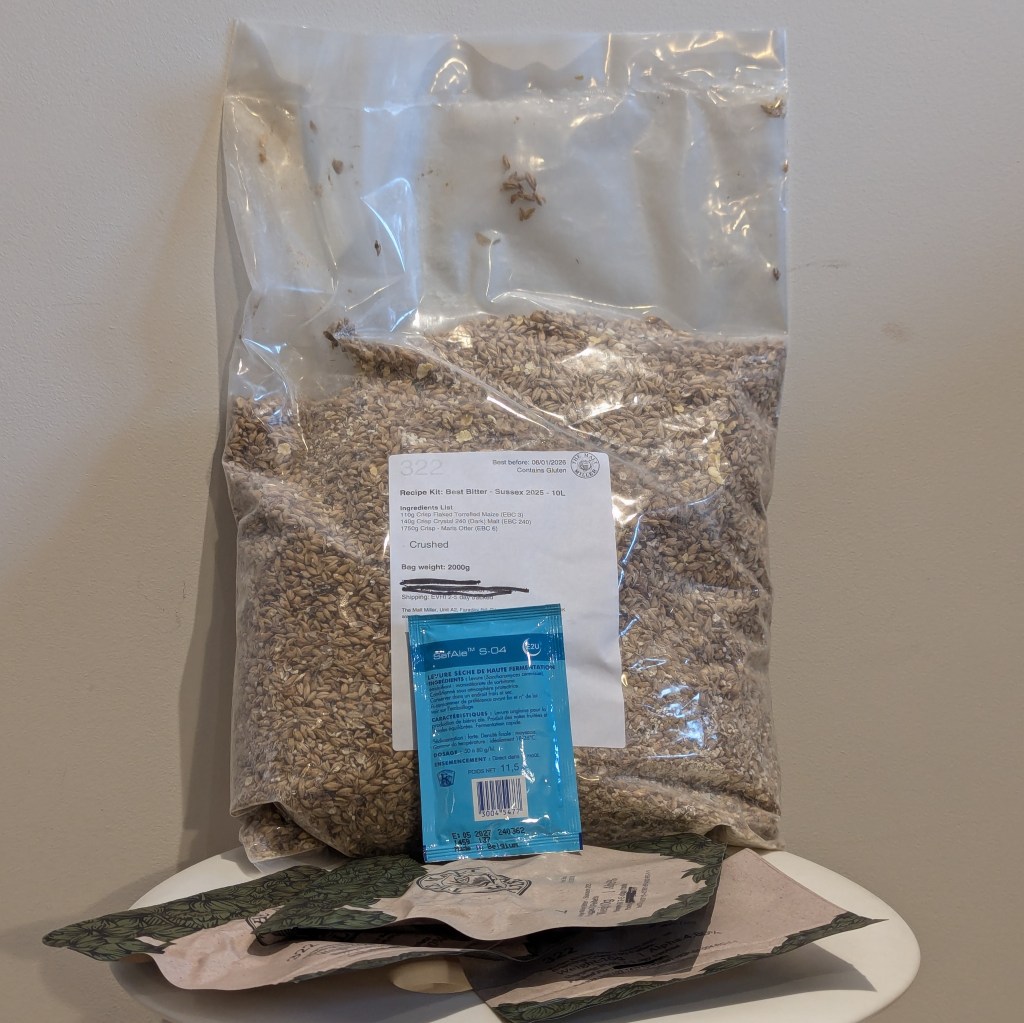
Maris Otter – 87.5% – 1,750g
Dark Crystal – 7% – 140g
Flaked Maize – 5.5%- 110g
I’ve found maize referenced in some SBB clone recipes and considered not using it for simplicity, but I think the crispness and dry finish of PBB and LBB should not be underrated. I’ve also increased the amount of dark crystal compared to a clone recipe as it looks to end up being lighter than SBB in my opinion.
My ABV is a little higher than both SBB and LBB but matches that of PBB. I’ve done this partly to keep the total grist at a solid 2kg weight to make the percentages easier but also gives me some wiggle room on efficiency.
Hops:
10 g – Bramling Cross – 60 min
10 g – Fuggle – 30 min
10 g – East Kent Goldings – 5 min
I considered using Sussex hops over Fuggles for the name’s sake. They contribute similar qualities, but Sussex looks to be more bitter and is also missing in Brewers Friend. I like the simplicity of the above hop schedule too and you really can’t go wrong with fuggles in this style.
A little less bitter than the 35 IBUs predicted in SBB, on Untapped LBB is listed as 29 IBUs and nothing is recorded for PBB. Best Bitters have a range of 25-40 IBUs, so this is pretty bang on.
Yeast:
Fermentis – Safale S-04 + 5 g yeast nutrient
I’m aware that I’ll never be able to replicate the yeast character of Havey’s due to the unique environment of their brewery. Apparently, a wet yeast is available that could potentially be one of their sach strains but I’m committed to using a dry yeast as it suits my scale.
I’ve considered using S-33 or even co-pitching to get more fruity esters, but the Belgian aspect of this yeast appears to be overstated and the esters more suited for a NEIPA. Also, it doesn’t flocculate as well as S-04 and clarity is a big deal here.
Technique:
Mash at 67°C for 60 minutes
Sparge water temp 77°C
Boil for 60 minutes
I also plan to split this batch after primary fermentation is complete, half will go in bottles as a clean ale and the rest will age in a demijohn with some BR-8 pitched. I’ll hold on to this for a few months at least for some brett character to develop.
Whilst researching the bitters of Sussex for my recipe I made a list of some other more notable trad-leaning Sussex ales that I’ve had that are worth trying:
Dark Star – Hop Head
Dark Star’s beers are now brewed at Fuller’s in Chiswick, but this used to be made less than 10 km from where I grew up. I love this beer on cask, at 3.4% it’s super sessionable and very clean, super bitter with tons of bright aroma from Cascade. Due to now being owned by Fuller’s/Asahi, it is also quite widely available in their pubs and is a nice contrast to London Pride.
Hand Brew Co – Bird Bitter
From a lovely modern brewery in Worthing with a great selection, covering everything from fest beer to Welsh red ale. Their Bird Bitter makes for a classic yet super clean and easy drinking bitter.
Burning Sky – Porter
Not to be confused with their robust porter, which is also very good, this more sessionable beer I’ve seen around on cask is delightful.
Gun Brewery – Scaramanga
Whilst Gun is well known for producing more modern leaning beers, they put them out widely on cask. With a lot of their beers being gluten free they have a unique presence and think Scaramanga is a great example of this.
Harvey’s – Old Ale
This a true god tier ale that steers away from the convention of making old ales stronger beers. Instead, this beer packs a deep and luxurious experience into
Hepworth – Sussex Pale Ale
I remember this being a favourite at various summer festivals at I think the house beer for a while at the Brighton Dome.
Arundel Brewery – Sussex Gold
What I love most about this brewery is how they traversed the UK’s shift away from trad-beers. For as long as I’ve been aware of them, they always produced a range of both solid classic British ales alongside modern craft beers which has since grown to be their focus. But I recall Sussex Gold to be fantastic beer, and I am so glad to see they continue to produce a classic range of ales.

 Babette’s Yeast
Leave a reply to Best Bitter 2025 – Part II: Recap – Babette’s Yeast Cancel reply