Porter of a Lady on Fire: For years I have wanted to name a beer after Céline Sciamma’s 2019 masterpiece Portrait of a Lady on Fire. Released in the UK just before the pandemic where I would begin to dip my toes into homebrewing, this film has made a lasting impression on me with a visual brilliance similar to that of Babette’s Feast.
I ordered this recipe from Malt Miller in late 2025 and I have sat with it whilst I’ve tweaked my process with my new equipment. I love both porters and smoked beers, the two do often meet and make for some fantastic beers like a recent porter I tried at the Strahov Monastery brewery in Prague. This will hopefully be my first attempt at a recipe I can return to each year and build upon.
Recipe
Boil Time: 30 mins
Mash Time: 60 mins
Batch Size: 10 liters
Mash Water: 10.07 litres
Sparge Water: 4.8 litres
Pre Boil Size: 13 liters
Post Boil Size: 10 liters
Pre Boil Gravity: 1.047
Post Boil Gravity: 1.053
Final Gravity: 1.013
Fermentation Temperature: 20
ABV: 5.3%
Grist
Crisp Malting’s Finest Maris Otter Ale Malt – 62.5%
Weyermann’s Smoked Malt – 20.8%
Crisp Malting’s Brown Malt – 8.3%
Crisp Malting’s Chocolate Malt – 4.2%
Crisp Malting’s Extra Dark Crystal – 4.2%
It has been so long since I put this recipe together that I can’t exactly remember all my reasoning. I believe I based the balance of speciality grains off of Crisp’s London Porter but subtracted the rye for more brown malt to enhance the colour and flavour. I kept the smoked malt at around 20% as this is often suggested as a good starting point. I’ve previously used oak smoked wheat in my beers, even in high percentages. However, I believe smoked barley varieties often impart more flavour, hence the caution here.
Hops
Fuggle – 5.0%AA – @ 30 min for 27 IBUs
I had actually scaled this recipe wrong when moving it from Brewers Friend to Brewfather, which I only discovered on brewday. I decided to keep this as a single addition at the start of the boil but reduced the boil time to 30 mins.
Water
15 litres of mineral water from Lidl.
| Ca+2 | Mg+2 | Na+ | Cl– | SO4-2 | HCO3- |
| 35 | 16 | 7 | 9.4 | 30 | *bottle doesn’t say |
Yeast
Fermentis SafAle English Ale S-04 – 2 packets.
I can’t remember the last time I used this yeast but I know it to be reliable. I will be fermenting this at 20 degrees celsius, after the trouble with my mild I don’t want to risk a long lag phase or stalling fermentation.
On a side note I have been toying with just using fuggle and S-04 for a number of upcoming recipes as a way to hone in on my approach to brewing and focus on a bit more on the grist. So perhaps think of this as a trail run.
Brew day
The brew day was relatively fast and smooth. My only major hiccups were not taking a proper pre-boil reading (as I used 3 small kettles) and having not scaled the hops in Brewfather.
Mash
Mash Time: 60 mins
Mash Water Vol: 11 litres
Mash-in temp: 65
Mash-in PH: 4.9
Mash high temp: 68
Mash low temp: 64
Mash-out temp: 72*
Mash out PH: 5
Mash out grav: 1.059
*I performed a mash out step by raising temp to 72 degrees and holding for 5 mins. (In future I may want to raise this to 75 degrees or above).
Mash notes: mashed in gradually which may have dropped the temperature lower than 65, however by the time I started the timer it was stable at 65.5. I did not bother insulating the mash tun and it seemed to hold just fine.
Sparge
Sparge Vol: 4
Sparge notes: took a sample in the middle which was very thin and low gravity, so have not used these numbers at all.
Boil
Boil Time: 30 mins
Pre Boil Size: 12 litres
Pre Boil Gravity: 1.045*
Pre Boil PH: 5 *
Post Boil Size: 10+ litres
Post Boil Gravity: **
Post Boil PH: *
*The pre-boil sample was a blend of the 3 pots used so not entirely accurate.
**I skipped pulling a post boil sample as I was using 3 pots.
Boil Notes: I decided to use 3 small pots to boil this, mainly for speed but also to ensure the wort was boiled (unlike with my mild). No yeast nutrient due to my previous questions around
the PH shooting up. I also noticed my hop addition was wrong in brewfather, so my bitterness is actually more than expected. Therefore I could afford a shorter boil time of 30 mins
Cooling
Cooling notes: All three pots cooled on the balcony for an hour or so. Once the temperature felt cool enough, I transferred all the pots to the fermenter, it was about 40ish degrees and I got the following gravity and PH. I also avoided adding as much of the trub as possible whilst also gaining a reasonable volume. I believe some of my fermentation issues in the past may have been caused by this. Once in the fermenter I put the bucket in the fridge to cool further. Whilst this will take longer than cooling outside, I won’t overshoot the temp.
Fermentation
Finally Batch Size: 9 litres (dumping as much trub as I could)
Original gravity: 1.053
Starting PH: 5
Yeast Pitch Temp: 20 degrees
Temperature Set: 20
H Limit: +0.5
C Limit: -0.5
Notes: after cooling overnight in the fridge, I aerated for 5+ mins then pitched 2 packs of S-04 (10:15 am). I have not insulated the bucket this time.
Day 1: I think fermentation started pretty quickly, certainly after 12 hours there is some strong airlock activity. Very different to my last batch.
Day 2: Fermentation is still going strong, the krausen has now dropped but airlock activity is still very frequent. Smelling good and healthy.
Day 4: Fermentation has slowed down but still some steady airlock activity. This morning, when I checked the fridge the probe had fallen off the bucket so I think the temperature had risen throughout the night (as high as 24 degrees). This has now been secured.
Day 8: gravity is reading as 1.018, so still a little way to go. I’m going to raise the temp to 21 degrees to hopefully help push this along. The sample has some light off flavours, perhaps it’s a little green. There is some light smoke to it, which I’m pleased by. The taste is pretty full on, maybe a little too sweet. Quite tense mouthfeel, so I am hoping we can dry this out a bit more.
Day 12: hydrometer is reading as 1.016, I’ll keep the temperature at 21 degrees and check back on day 14. If it has moved, then I’ll have to hold off on bottling. If it is stable, I’ll proceed.
Day 14: I think the gravity has dropped another point,1.015. PH is 3.9. I can’t bottle as I don’t think it is stable, but this is some slow progress. I’ve increased the temperature to 21.5 and pitched 1 pack of Nottingham yeast to hope to keep this chugging down.
Day 19: gravity hasn’t changed so Nottingham hasn’t really done much. I’m going to raise the temperature to 22 to encourage a bit more attenuation.
Day 28: I took a gravity reading that said 1.016 (4.9%), so I’m not sure if it ever did drop. The PH reads as 3.3, so despite the stable gravity I’m pretty sure I am looking at an infection. This may or may not be connected to the over carbonation issues I’ve been having with my packaged beer, however I’ve never had a beer turn sour like this. I have now dumped the batch as it will too unstable to package. This is sad as even with the acidity it was tasting quite nice, but not really what I was going for.
Tasting Notes:
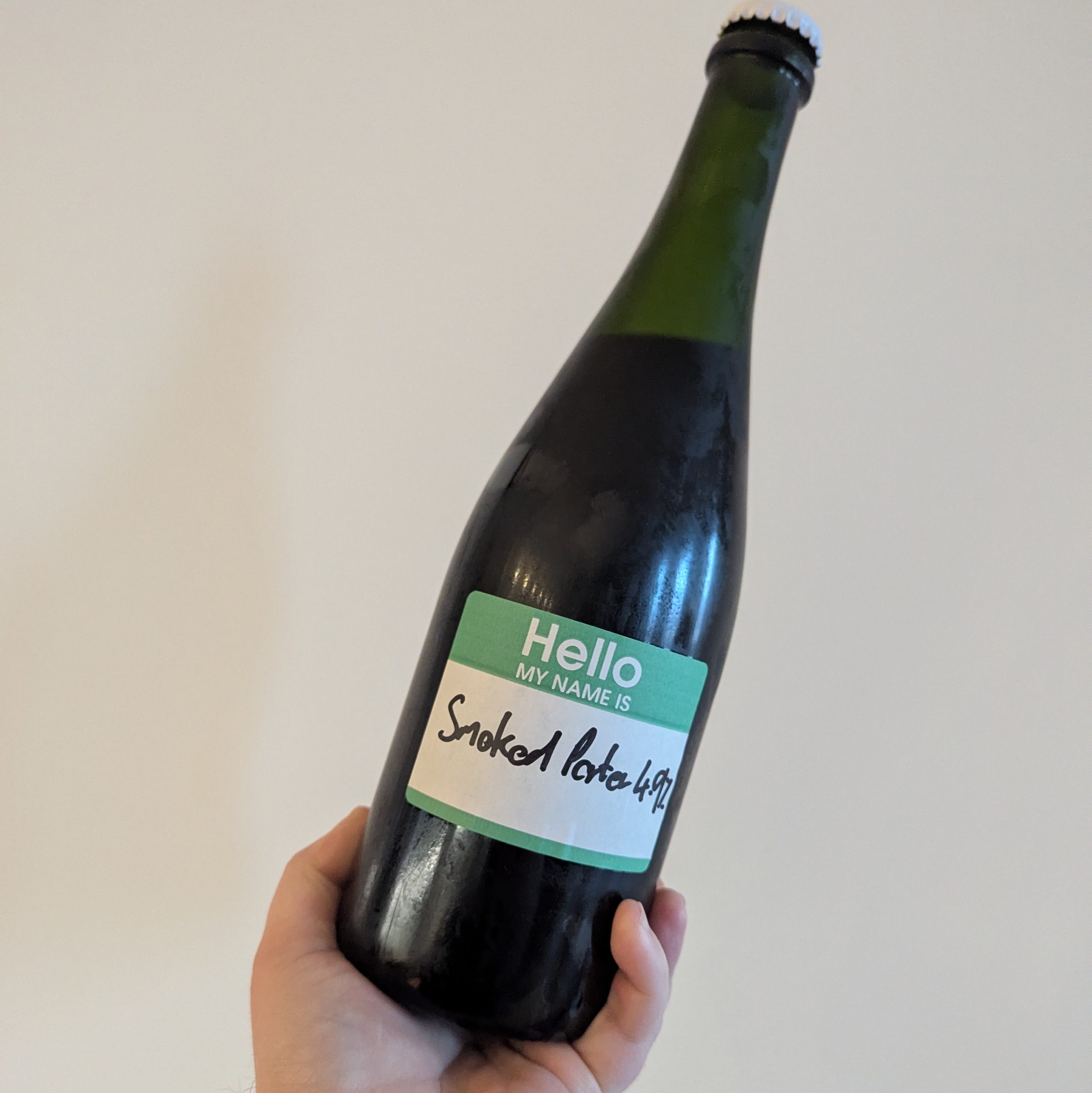
I did manage to get one sample in a 750ml champagne bottle that I carbonated with a single carb tab. I opened this after only one week of conditioning to avoid a bottle bomb/gushing, here are my notes:
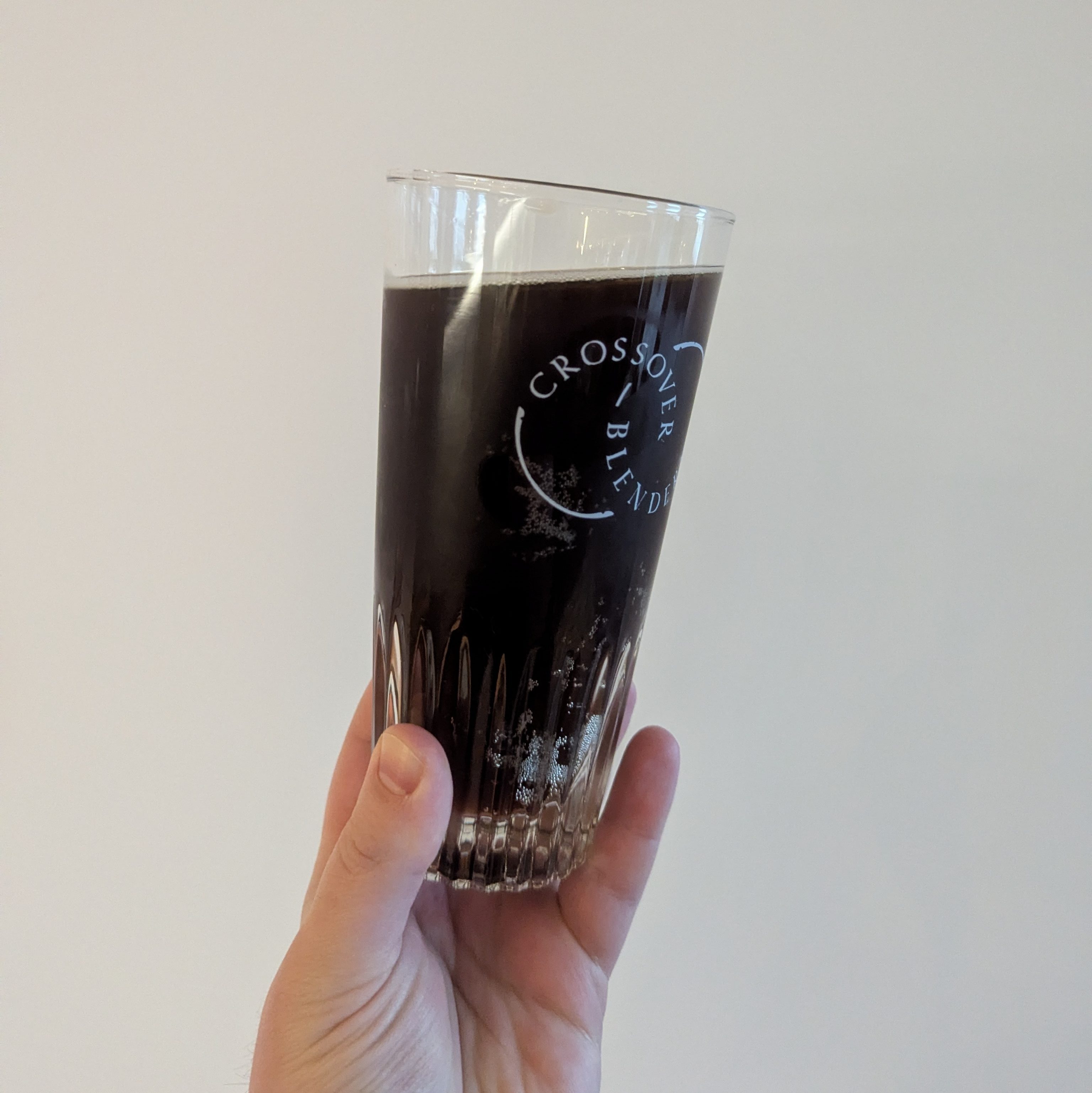
Look: A dark brown with a murky golden hue murky, like ice tea with a tan head that vanished fast.
Smell: Slight red current almost Red Bull fruitiness plus chip shop synthetic malt vinegar and a nice level of smoked malt.
Taste: Quite zesty and sharp, red fruits, brown toast and smoke.
Feel: Quite a strong acidity (I think both acetic and lactic), low to medium bitterness, dry, flabby, a bit astringent and even a little cloying. Very low carbonation but to be expected after just one week in the bottle.
I think the recipe itself is not so bad and with the proper execution there is probably an alright beer to be made. The levels of smoke are pretty spot on for what I wanted, the bitterness also felt balanced. I’d perhaps dial back on the roasted grains, to curb some of the astringency.
Definitely the stressed yeast from the raised temperature has pushed a fruitier and faulty aroma and flavour. The under attenuation, a continued issue I am having, is also something that concerns me. And then there is the obvious acidity which I think is more likely down to contamination from my equipment.
When I shared my mild, some of my fellow brew club members did propose Saison yeast as a potential culprit for this under-then-over attenuation. I have previously made saisons with this fermenter, potentially via poorer cleaning practices, this stubborn yeast has remained within my equipment. Saison strains usually highly attenuate, which is perhaps the cause of the issue after packaging.
But what about during Primary fermentation? I suppose it could cause lower attenuation by competing with the intended yeast under unfavourable conditions. The Dupont strain, which I last used for a saison, is also known to frequently stall and requires a much higher temperature range, which could explain why this issue is also happening later in the process. Saison strains are also known to be killer strains too, which could be preventing the pitched yeast from finishing the beer.
All of this is food for thought, and improving my cleaning process is evidently needed. I have also purchased a new bucket fermenter, this will be used for my next batch so I am really hoping for an improvement. More beer to come soon.
 Babette’s Yeast
Leave a comment