Mild Tales: When I started homebrewing in 2020, I named each beer I made with a play on words of a film title, just for fun and to potentially build recipes to revisit. I never really stopped doing this, but it is something I’m going to include in my write ups.
I’ve called this recipe Mild Tales after Damián Szifron’s 2014 film Wild Tales, a black comedy structured in six episodes that explore violence, anger and vengeance. I first saw this film when I was a lucky student with accreditation at Cannes, and it has stuck with me ever since. If I were forced to draw a connection between the film and the beer style, I’d say how the film traverses extreme examples of everyday strife is somewhat similar to how mild is a style for everyday people but with an incredible ability to be punchy and bold.
After a rather shoddy first attempt brewing with my new set-up, I kicked off 2026 by brewing a mild. My logic was, if I can try to knock out a somewhat simple and clean beer style, it could help me identify the holes in my process. I’ve also used this as an opportunity to trial using Brewfather alongside Brewers Friend.
Recipe
Boil Time: 60 mins
Mash Time: 90 mins *single infusion no sparge
Batch Size: 10 liters
Mash Water: 7 litres
Pre Boil Size: 14.46 litres
Post Boil Size: 10 liters
Pre Boil Gravity: 1.028
Post Boil Gravity: 1.035
Final Gravity: 1.009
Fermentation Temperature: 18.5
ABV: 3.4%
Grist
Crisp Malting’s Vienna Malt – 92.5%
Crisp Malting’s Dark Crystal Malt 240 – 6.3%
Crisp Malting’s Chocolate Malt – 1.3%
The colour for this beer should finish up much lighter than the ‘dark mild’ guidelines. This is partly to do with the parameters for the style being different in Brewers Friend when I first planned and purchased this recipe. Whilst I had intended for this to be on the lighter side of the scale, it is now much more aligned with an Ordinary Bitter in terms of colour. Some of the traditional Mild’s in Brew Your Own Real Ale At Home (BYORAAH) by Graham Wheeler & Roger Protz do also fall on the lighter side of the ‘dark mild’ guidelines, so I don’t think this is a wild deviation.
Additionally, choosing Vienna as a base malt might seem a strange choice over a British pale variety, but as I’ve chosen to be a bit lean with the crystal and roasted grains to keep the colour light, this should add depth, increase bready and nutty notes, whilst also keeping the astringency low and body light. Crisp has an interesting recipe online that uses Vienna as base malt in this way, but they do suggest mashing for 90 mins to ensure full conversion as the Vienna Malt has fewer amylase enzymes than regular pale malts. So I shall follow this advice.
Hops
Boadicea 5.9%AA – @ 30 min for 17 IBUs
I had planned to just use Fuggles for safety but my fear here was that I may just find this boring after a while. Using a single variety in this beer should make for a good opportunity for me to learn a bit more about a new hop. Boadicea, whilst not super classic UK hop, is well known for its clean bitterness and mild, spicy, floral qualities.
The IBUs are well within the style, but much like with the colour, as I’ve moved the recipe between applications I’ve noticed some differences. According to Brewfather this will now land at 17 IBUs rather than the 22 I had originally planned for using recipes in BYORAAH as a bench mark.
Water
15 litres of mineral water from Lidl – Usually I’d use the Ashbeck bottles from Tesco but I can’t seem to find the 5 litre bottles of this at the moment. The mineral content for this Lidl water is as follows:
| Ca+2 | Mg+2 | Na+ | Cl– | SO4-2 | HCO3- |
| 35 | 16 | 7 | 9.4 | 30 | *bottle doesn’t say |
I’ve also now planned to run this without a sparge, this is mostly down to temperature control for the 90 min mash. It should be easier and more consistent to hold the mash temp at 72 degrees with a greater mash volume.
Yeast
1 pack WHC Old English
+5 g yeast nutrient *added in the boil
I could have used S0-4 or Nottingham as I have both of those on hand but, much like with the hops, this should be a good time to try appropriate alternatives and see if my results improve.
Brew Day
Mash
Mash Time: 90 mins
Mash Water Vol: 12.5 litres
Mash-in temp: 71
Mash-in PH: 5.1
Mash halftime gravity: 1.036
Mash high temp: 72
Mash low temp: 66
Mash-out temp: 66
Mash-out PH: 5.1
Mash notes: Mash stir frequency: Mash-in, 75 mins, 45 mins, 15mins, mash-out .Temp check frequency: every 15 mins. Insulated mash tun and lid with foam. Tried to run this without a sparge but could not fit all 15 litres in the tun. Very full tun, very thin mash.
Sparge
Sparge Vol: 2.5 litres
Sparge notes: I hadn’t planned to sparge at all. I heated the water to boiling and then left to cool to 70. Poured through easily and collected more wort than I’d thought. The colour was caramel/amber.
Boil
Boil Time: 75 mins *96 degrees
Pre Boil Size: 13 liters *rough
Pre Boil Gravity: 1.032
Pre Boil PH: 5.2
Boil halftime gravity: 1.035
Post Boil Size: 12 liters
Post Boil Gravity: 1.036
Post Boil PH: 5.7? This seems strange, how could it have become less acidic in the boil? *I believe this is caused by adding the yeast nutrient.
Boil Notes: As I was struggling to reach an actual boil I extended the ‘boil’ time to 75 mins to keep up the bitterness and boil off rate. But as this was only at 96 degrees according to Brewfather, this wouldn’t really help me, so the bitterness has dropped down to 13 IBUs. The gravity looks to fortunately still be in a good place, the volume is rather high, and I’m hoping the extended ‘boil’ would lower my chances of getting hit by DMS.
Cooling
Cooling notes: I’ve stuck this out on the balcony where it is currently -1 outside. I left this overnight, which was far too long and woke up to find in sub 10 numbers. I have waited all morning and afternoon for the temp to rise enough for me to pitch. It is now at 17 and I have pitched the entire pack of yeast. I have wrapped the fermenter with the insulation and popped into in the chamber with the door open so that the temp can creep up
Fermentation
Batch Size: 12 liters
Original gravity: 1.035
Starting PH: 5.7
Yeast Pitch Temp: 17
Temperature Set: 18.5 *raised to 20 after 48 hours
H Limit: +0.5
C Limit: -0.5
Notes: For the PH test, I let the sample rest and still got 5.7. The gravity was checked against the hydrometer, which I then converted at different temps. I also used the refractometer and got the same result. When tasting the wort I noticed that whilst not super sweet it still has a noticeable clean bitterness.
Day 1: The fermentation smells like it has started but hard to tell with the fermenter insulated. The airlock activity is very slow, so not entirely sure if this has really kicked off yet.
Day 2: Still doesn’t look like fermentation is in full swing. I’ve now received my heat pad so set that up and raised the temp to 20 degrees. I’ve also taken a gravity reading using my refractometer and there has deficiently been some attenuation. Gravity is sitting at 1.019 (after FG conversion). The sample doesn’t smell infected, a little sulphur, the taste is bitter, but with a lot of roast.
Day 3: The gravity looks to be the same as yesterday, so I’ve assumed a stall. I’ve kept the temp at 20 but pitched another pack of yeast and roused the wort. It looks like this has made some difference as there appears to be some airlock activity, albeit slow.
Day 7: The gravity is at 1.016 which is 8 points higher than I’d have expected. Equal to 2.6% abv. I’ve raised the temp to 21 degrees to hopefully encourage more attenuation (if it’s stalled/sluggish). 1.013 is the top end of the style guidelines, so I’m hoping to get it under this. I’ll check the gravity in a few days and add some simple sugars if needed to get this going again. I’m now considering priming with a sugar solution (rather than carb tabs), this way I can target a lower carbonation (better suited for the style) and perhaps steer away from gushers should fermentation kick off in the bottle.
Day 11: The gravity only dropped a further point to 1.015 (2.7%). I’ve raised the temperature another degree, hopefully pushing this a bit further along. I had planned to bottle this after 2 weeks but if the gravity has dropped by this weekend I may continue to let this go, and bottle after 3 weeks.
Day 14: I think I now have a gravity of 1.014 (2.8%). I shall keep the temperature the same for the rest of the week. The aroma is now fruiter and not as pleasant, perhaps a bit oxidized. The colour is also darker. The taste is okay, fruity and a bit flabby and thin. Potentially considering dumping the batch, or at least only bottling part of it.
Day 21: The gravity is still 1.014, and as much as I’d like to dump the batch, I will push on and bottle this. I’ll only bottle 5x 750ml champagne bottles, each dosed with 1 carb tab. The carbonation will be deliberately low (if this is indeed the final grav). And if it does continue to ferment this should be obvious when the bottles open, but without blowing up. The PH was 3.8 and is not tasting all that bad, but oxidized and flabby.
Tasting notes:
After conditioning in the fridge for 2 weeks at 21 degrees, then chilled in the fridge for 2 days prior to tasting.
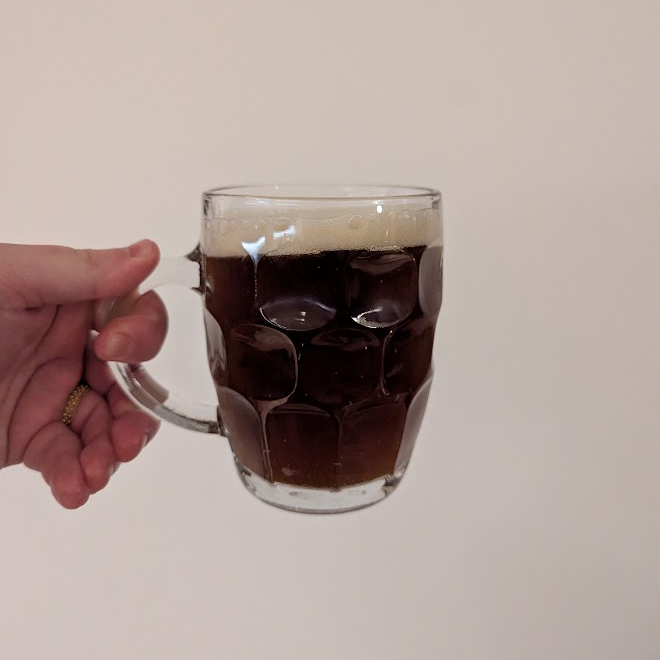
Look: Dark copper/amber, clear, foamy off white head that forms thick but fades fast.
Smell: Mixed berries, fruit of the forest, red apple, maybe a little yoghurt and some faint roast. I got some off flavours, perhaps harsh alcohols, and acetaldehyde.
Taste: A definite sweetness, not particularly rich with caramel, more like that of an AF beer. Still, it has light biscuit malt quality, tons of fruit flavour, fresh pear, white grape, red current. It also has this mineral quality I get in British beer styles that I like.
Feel: Quite a thin body, the carbonation is light but is on the mark for what I wanted. Not cask-like in texture but has a similar fizziness. A bit cloying and a touch acidic on the tongue, low astringency and a mild bitterness.
Considering the PH and attenuation issues, I am not so unhappy with how this turned out. There is much work to do with improving my approach to mashing and now that I have the heat mat in place, I will have greater temperature control.
After conditioning for another 4 weeks in the bottle, I have found the latest sample to be a gusher. I have been having this issue a lot recently and believe it is arrested fermentation, where after eating some simple sugars in the carb tabs, the yeast continues to munch on the remaining gravity that failed to drop in fermentation. Using a lot of assumptions, I’d guess the beer was supposed to be primed to 1.5 vol of CO2. For the gentle gush that I got, I’d say it was probably at 3.0 vol of CO2. Dropping 2 gravity points gives you an increase in CO2 vol of +1, so, let’s assume for now this has actually dropped 3 points, down to 1.011 to reach the effect of 3 vols of CO2. So I am glad I used the champagne bottles for this beer but disappointed that this issue persists even with 3 weeks of primary fermentation.
 Babette’s Yeast
Leave a comment