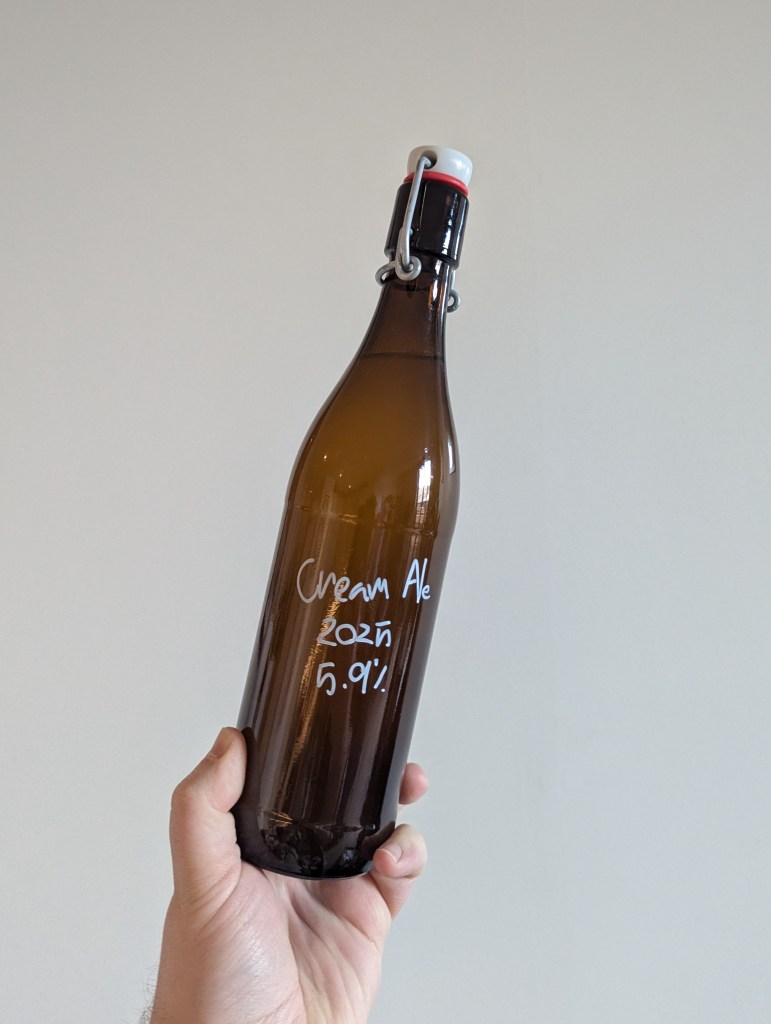
Back at the start of January I kicked off 2025 with my first attempt at a cream ale. This was with the goal of having something to share in my homebrew club’s April meet-up which was focussed on the style. You can read my previous post of my recipe development here.
Targets:
Volume: 10L
PBG: 1.034
OG: 1.044
FG: 1.008
ABV: 4.7%
IBUs: 16.9
SRM: 3.1
Recipe:
Water: Mineral Water
Malt: 85% Extra Pale Malt & 15% Flaked Torrefied Maize
Hops: Fuggle
Yeast: US-05
Mash:
I mashed my grist into 5 litres of mineral water heated to 62 Celsius, which in hindsight is too low. Throughout the hour of mashing, I recorded highs of 72 but never creeping lower than 62 degrees.
Sparge:
I sparged with another 5 litres of mineral water heated to around 65 celsius and recorded a pre boil gravity of 1.053.
Boil:
I boiled the wort for 30 mins with a first-wort addition of 8 grams of fuggles and 4 grams at 10 mins, along with 4 grams of yeast nutrient.
Cooling and Yeast Pitch:
I cooled the wort in the sink for 20 mins, then added the wort to my bucket fermenter along with 2 litres of fridge temp mineral water. I aerated and recorded an original gravity of 1.063, and 8.5 litres of volume. I proceeded to pitch half a pack of US-05. What I didn’t do is record the pitch temperature, which I suspect was rather high.
Not a bad brew day, I remember being pretty efficient timewise but I didn’t hit the right temperatures in the mash and the cooling stages and also over shot my boil-off rate. This resulted in a higher gravity and lower volume than expected as well as potentially creating a stressful environment for the yeast as well as possibly under pitching. The fermentation was quite straight forward as was the bottling, however I was surprised it had attenuated all the way down to 1.006, meaning a ABV of 5.9%.
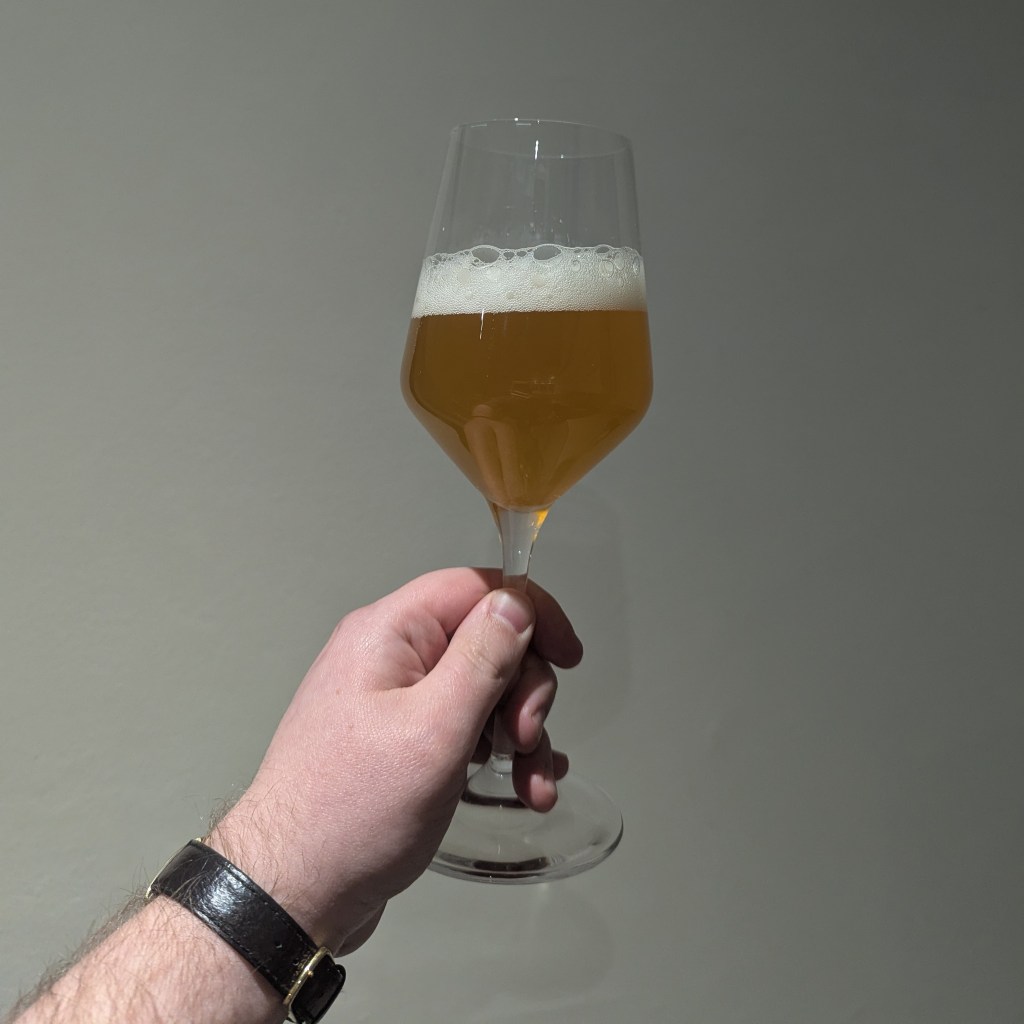
Later in February I sampled the first bottle, it poured a hazy straw colour with a thin white foam that quickly vanished. The aroma was quite yeast forward with red fruit esters of raspberry, red apple and some banana. It had medium to light malt sweetness with a touch of mint and minerality, not earthy though. The carbonation was a little low but still felt quite crisp with a touch of creaminess, with the low bitterness it was quite morish despite the high ABV.
I was quite happy with this initial tasting and we opened many bottles through February and March and made some notes on how it developed before bringing along to our homebrew club for feedback.
The colour didn’t change a great deal, keeping a bright hazy straw colour, but the head retention improved, gaining a lovely thick creamy top. The aroma shifted slightly too away from red fruits and more towards peach and certainly more earthy and peppery with a touch of alcohol heat too. The flavour became more influenced by the yeast with a fruitier peach and white grape flavours and a subtle biscuit note. But what changed the most was that it was now over carbonated with a number of bottles gushing on opening. The carbonation wasn’t harsh with the bubbles feeling very smooth, the bitterness still felt low but the beer was now drier and perhaps thinner.
It occurred to me later that the change in carbonation and dryness might indicate it had become infected. As there was never any acidity or funkiness, I felt it could be plausible that the first sample I had may have been too young and/or the yeast had stalled before bottling and continued to attenuate malt sugars in the bottle.
As our April meeting was cream ale focussed, we went through eachothers beers and shared feedback. There were some really good examples of the style, with a range of crisp, clear and flavorful beers using a variety of techniques.
The feedback I received highlighted that the yeast was likely stressed and producing esters and off flavours that are not typical or desirable for a cream ale. However, this character was still received as rather pleasant and quite drinkable by some, positioning it more as an accidental saison. There were also some comments that it had the right creaminess to the body which I’ll take as positive as I felt it was too thin. I did raise whether anyone felt that there was any indication of infection but no one suggested anything. Certainly not a cream ale by group assessment but also not an absolute failure.
Whilst I can’t control fermentation temperature, I would put my failure of yeast health down to a combination of too lower pitch rate and too higher pitch temperature which set the yeast off on an uphill battle. Additionally, having a higher than expected gravity only made the pitch rate even more inadequate and my lack of temperature control would have only made for an increasingly stressful environment. These are all points I hope to address when I pick up brewing again in the cooler months. I will now try pitching an entire pack of yeast for my 10L batches and ensure I get the temperature down lower to avoid extra stress on the yeast.
I really enjoyed brewing this cream ale as it allowed me to build a recipe to fit my process and environment. Whilst the beer was by no means perfect it has proved to be quite refreshing and I’ve sadly run out of the big bottles ahead of Summer. I will keep hold of the two remaining 330ml and perhaps recap this beer along with some others at the end of 2025.
 Babette’s Yeast
Leave a comment